The Fundamentals of Credit and Banking
Credit and banking are the cornerstones of the modern consumer lifestyle. By mastering the basics today, you can put yourself in a position to prosper tomorrow.

Credit and banking are the building blocks of modern consumer life. Trying to get by without participating in either industry has become just about impossible in today's society. That means it's imperative that you understand the basic elements of both, as failure to do so can lead to serious financial quagmires down the road.
So without further ado, let's dive into the fundamentals of credit and banking.
A Crash Course in Credit
Here's the undeniable truth: Good credit makes life vastly easier to navigate. You'll pay less for everything, which will leave you with more money to spend elsewhere. You won't have to worry about bad credit affecting your chances at getting a car loan, a mortgage or even a job.
Yet despite these very tangible benefits, millions of people struggle to keep their credit clean. Too often, a simple lack of financial education is to blame. So let's review how the credit system operates.
First, there are three main credit reporting agencies that monitor your repayment history. These agencies compile information about all of your payments to various creditors and utilities and put this information into a credit report. This report contains all your repayment data, good and bad.
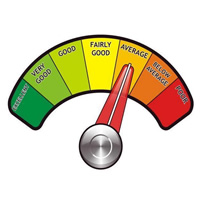
This information is also used as the foundation for your FICO score (often simply called your credit score). This score, which ranges from 300 to 850, measures your creditworthiness. A higher score is better -- and more likely to help you qualify for a loan. Roughly speaking, 700 is "good," 650 is "fair," 600 is "poor" and 550 is "bad." It's important to note, however, that these numbers do shift somewhat depending on the nature of the loan you're seeking.
While a bad score can have a seriously negative impact on your life, there are ways you can rehabilitate your score. By paying off your debts, making timely payments and increasing your available credit you can improve your credit almost immediately. For those in deeper debt, more drastic action such as bankruptcy protection may be needed.
Whether your credit is spotless or troubled, it's important to search for the best interest rate you can find. This applies to credit cards, mortgages, car loans and anything else. It's always a good idea to comparison shop. When comparing credit cards, you'll want to look at APR (annual percentage rate), a number that tells you how much you'll be repaying in interest every year. In general, low single digits is preferable.
It is important, however, to read the fine print. Sometimes a low APR is only in effect for a limited "introductory" period, after which a much higher rate kicks in -- much like a mortgage that offers a fixed rate versus an adjustable rate.
What to Look for When Banking
Much like a low APR when you're checking out credit card offers, interest rates should be one of your primary considerations when you're evaluating bank accounts. In this case, however, you want a higher rate -- because the bank is paying you.
As you might expect, these interest rates are usually vastly lower than the rates you'll pay the credit card company. Still, an extra one-percent can make a considerable difference to your account over the long run.
Additionally, when evaluating banks it's important to review their fee structure closely. Essentially, you want to find a bank that offers the lowest fees and charges possible, as there is very little to differentiate most banks in terms of services.
The Takeaway
Credit and banking are the cornerstones of the modern consumer lifestyle. By mastering the basics today, you can put yourself in a position to prosper tomorrow.
Related Topics




About MIDFLORIDA
Since our founding in 1954, MIDFLORIDA has grown to serve members throughout the state of Florida, with branches coast-to-coast from Gainesville to Naples. Our products and services rival any local bank, while maintaining the credit union philosophy of excellent personal attention.